Showing posts with label computational thinking. Show all posts

Thursday, February 7, 2013

Myth #7: Digital Learning Develops Problem-Solving

8 Myths About Digital Learning

OK - I have to compromise on this one. I do believe that using digital tools develops the problem-solving skills necessary to use "new" digital tools.  In fact, I suspect that the thinking that leads children to succeed in any problem-solving digital game becomes a habit of mind that helps in solving similar non-digital, real-life problems.  Students who can, for example, advance steadily in Cut the Rope are more likely to be able make suggestions to get a team over a wall challenge or are more likely to contribute key language to a class constitution.

Here are some problem-solving basics (this is my own list):

  • I have to understand the problem and what makes it hard
  • I have to think about what I already "know" about the problem topic
  • I have to take a deep breath and think critically about what I read, see, think, feel, hear, and already "know" - throw out the unimportant, wrong, false, exaggerated, emotional, and biased
  • If I don't see a solution, I have to take a risk and try something different
  • If I do nothing, there will be no solution
  • I have to accept and learn from my mistakes, missteps, and failures
  • I have to give this time
  • If I find a solution right away, this doesn't mean I have the best solution
  • Some problems are too hard for just me
  • Being in a team has advantages, so listen to team members
  • Finding, keeping, and evaluating evidence and experience as I work for a solution is important
  • I have to test my solution (unless it obviously works)
  • Solving a hard problem gets me ready for an even harder problem and makes me better at similar problems
Problem-solving requires Critical Thinking. In education, Critical Thinking is today thought of as, well, critical.  As expressed in this post from Educational Technology and Mobile Learning, it has these elements:

Other researchers use different terminology for critical thinking skills:
It's In the Genes
Whichever language you choose, notice that individual judgment and opinion are embedded in these research models of Critical Thinking (on this point I quibble with critical thinking as applied by the Common Core to reading.  Personal response and previous knowledge matter. Enough said).  Note also that research supports that critical thinking skills can be taught, but also that once learned, they are not applied with automaticity by any individual.  Their optimum application in the classroom should, therefore, be monitored, and must be required.

The above research article (It's In the Genes) also states that problem-solving style preferences are innate (adaptive/narrow solution focused or innovative/wide solution focused).  This suggests to me that the design of an educational problem is, for many students, directly related to its outcomes - for an individual student and for a problem-solving team.  This requires a teacher or teaching team.

[Aside: the relationship between Problem-solving and Critical Thinking is a complex one, characterized by overlap and interdependence.  I have found this article to be very helpful in understanding the components of both as they related to education.]

So what?  It is clear to me that the skills of critical thinking can be assisted by digital tools, and to this degree digital learning does develop them.  Multiple cases have been made for the use of technology to enhance and develop each of the elements of critical thinking identified above.  Tools such as blogging and backchanneling can even develop the student's ability to self-examine and self-correct.

On the other hand, problem-solving is not developed, but supported, by technology. Ready access to information, including that previously explored and that converted to knowledge, and the communication of solutions and their analysis, are more easily done with facile use of technology than without.  But it only through solving problems that we get better at solving problems.  Ready access to multiple challenging problems may be better for students than extended access to one large, hard technology-rich problem.

So, when we speak of learning, we do better to speak of Critical Thinking.  When we speak of gathering and demonstrating learning - of the processes of learning (writing, reading, researching) - we do better to speak of solving problems.

I have touched on this previously:

Tuesday, January 15, 2013

Computational Thinking in ELA - Absolutely

[update: If you are a teacher of elementary level children, read Computational Thinking for Kids also.]

I am deeply reading Hoban's brilliant Riddley Walker. That is a key to my frame of mind. As I looked today at images of elementary school reading Anchor Maps - totally independent of Riddley - it occurred to me that every single one of those visual charts was applying basic principles of computational thinking (CT) to the reading task, whether it be of fiction or nonfiction.  In fact, I was applying the CT principles to my reading of my very complex novel.

It turns out that the same principles also apply to writing tasks.  Not surprising - the human brain is, after all, a computer that outputs (or prints out) 24/7.

What is CT?  The best, simple working definition for literacy purposes is this: "Computational thinking is taking an approach to solving problems, designing systems and understanding human behaviour that draws on concepts fundamental to computing"  (Jeanette M. Wing, Computational thinking and thinking about computing).  

A simple overview of CT for education is provided by iste.  Other resources can be found at Google's Exploring Computational Thinking site.

An overview of the CT problem-solving method (adapted from Jeanette M. Wing's Viewpoint: Computational Thinking) is important.  As you read the steps, think about your lessons and activities:
  • What is the difficult problem?
  • How is it difficult to solve?  
    • Consider the character's situation, background, resources, constraints
    • Consider the text - vocabulary, sentence structure, voice
  • Search, search, search - collect large amounts of data
  • Reformulate the problem into one we know how to solve, preferably by using computers (see chart below)
    • Reduction 
    • Decomposition
    • Embedding
    • Transformation / modeling
    • Simulation
  • Design a system to solve the reformulated problem
    • Be curious
    • Conceptualize, Abstract
    • Imagine
    • Think virtually, not realistically (daydream)
    • Use invariants - elements that will not change no matter what solution is applied (e.g. spelling, paragraph elements, the restrictions of the prompt, the list of known literary terms)
  • Ask: Is the solution good enough?
    • Is it aesthetically pleasing?
    • Is it correct?
    • Is it efficient?
    • Is it simple and/or straightforward in its design?
    • Can it be automated or expressed in algorithms?  
  • Apply the solution to other problems
Key points made by Wing about CT [my notes are to place this in a literacy setting]:
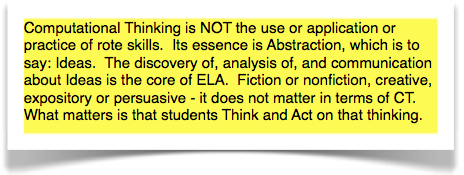
  • "The essence of computational thinking is abstraction."  (Wing)
  • "Computational thinking is thinking in terms of prevention, protection, and recovery from worst-case scenarios [illiteracy, low test scores] through redundancy [repetition of same and increasingly complex texts and writing], damage containment [knowledge of individual student's progress, holding students to high standards], and error correction [learning]." (Wing)
  • "Computational thinking is using heuristic reasoning to discover a solution [seeking a quick, workable solution to the problem at hand]."  (Wing)
  • Computational thinking is "having the confidence we can safely use, modify, and influence a large complex system [a text, a body of literature, a concept discussed in literature, how to write an essay] without understanding its every detail." (Wing)
Hey - the best, the most successful ELA teachers do this without the Common Core.  I have always known this (that is a heuristic statement, by the way, which would have to be supported by data and evidence in order to be part of a strong argument).  The more ideas, the better - the deepest CT comes from the interweaving, or layering, of ideas.  It requires experimentation with algorithms that can be used to inter-relate ideas.

Isn't this what deep learning is all about?  I don't find it at all odd or ironic that a concept that comes from the world of computer science has been applied in (not to) ELA since literature study began. If anything, ELA is the field most closely tied to the "human behavior" elements of CT.  Textual analysis may be the root of CT thinking (I like to think so).

So it is logical that, for ELA teachers, this 21st century toolkit is largely already embedded in what we do - no matter what tools we use.  You don't have to change anything to use CT.

Oh, and remember that the brain is a tool.

What exactly does computational thinking look like in the world of ELA?  Some suggestions are in the tables below, but there are hundreds more.  By conscientiously applying these Elements and Concepts to teaching, we teach better.  Learning is harder for all, but better.


I repeat:
  • Ask: Is the solution good enough?
    • Is it aesthetically pleasing?
    • Is it correct?
    • Is it efficient?
    • Is it simple and/or straightforward in its design?
Are we trying too hard to be 21st Century?